
How to Find Buyers for a Veterinary Practice

If you’re trying to work out how to find buyers for a veterinary practice, start by separating buyer access from buyer fit. Finding names isn’t the hard part. The hard part is identifying which buyers are serious, qualified, aligned with your goals, and able to protect the practice you built.
Veterinary practice buyers include individual veterinarians, local and regional practice owners, corporate groups, private-equity-backed platforms, and specialty and emergency groups. Each evaluates practices differently, and each creates a different reality after the sale for you, your staff, doctors, clients and patients.
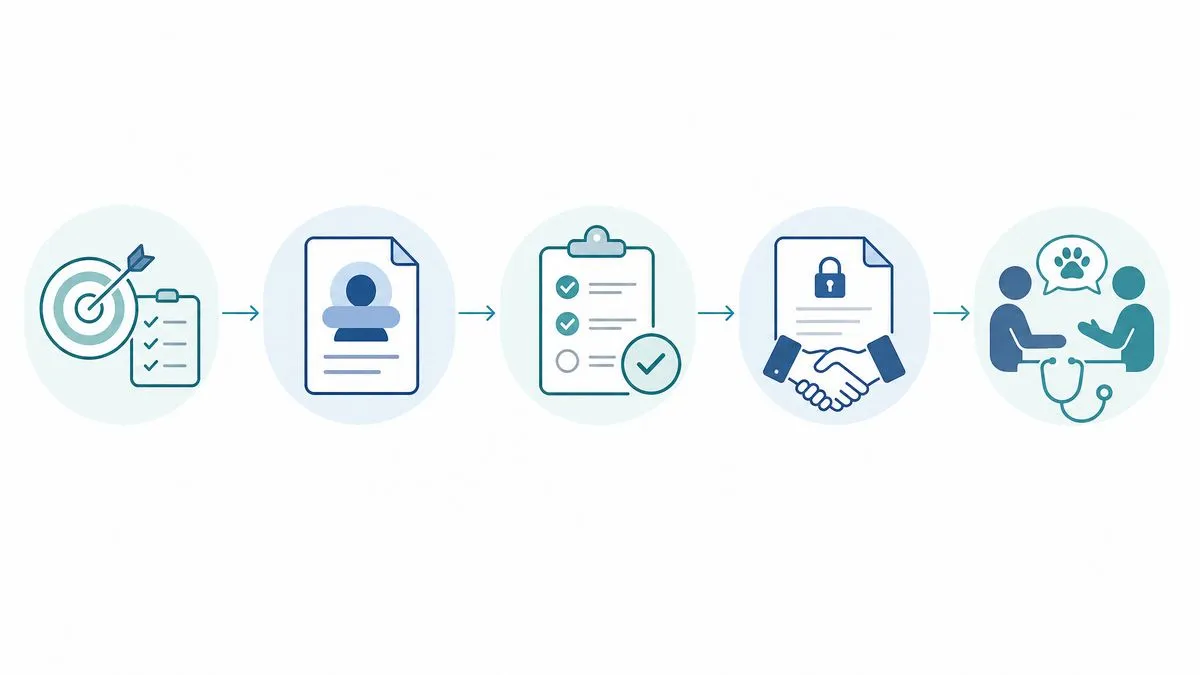
The best process isn’t always “show the practice to everyone.” A stronger approach is to define what you want, protect confidentiality, understand the buyer types, screen for fit, and share sensitive information only with qualified parties.
Five ways to find buyers for a veterinary practice
Owners usually use one or more of five channels: direct outreach to known buyers, a broker or adviser, confidential matchmaking, inbound interest from groups, or local conversations with other veterinarians.
Each can work, and each has trade-offs. Direct outreach gives you control, but it’s hard to know which buyers are active. A broker can run a broader process; some owners prefer that, others don’t want a public or semi-public campaign. Matchmaking suits owners who want targeted buyer conversations before committing to a full process. Inbound interest is convenient, but one buyer’s offer doesn’t prove you’ve found the best fit.
A good buyer search answers three questions:
- Which buyer types are likely to value this practice?
- Which buyers are serious, qualified and active right now?
- Which buyers best match your goals after closing?
Start with your goals, not the buyer list
Before contacting anyone, define the outcome you want. A buyer who’s perfect for one owner may be wrong for another.
- Do you want to leave quickly, or stay for a transition?
- Do you want to keep practicing medicine after closing?
- How important is keeping your staff?
- Do you want the hospital’s name and culture preserved?
- Are you open to corporate or private-equity-backed buyers?
- Would an individual veterinarian or associate fit better?
- Do you own the real estate, and is it part of the deal?
- How much confidentiality do you need?
Your answers shape the list. If continuity and culture matter most, the best buyer may not be the largest. If certainty and speed matter most, an experienced group may have the edge. If legacy and local control matter most, an associate, a local veterinarian or a smaller regional group deserves more attention.
The main types of veterinary practice buyers
Individual veterinarians
A local veterinarian, associate or entrepreneur who wants to own and run the hospital. Attractive if you care about continuity and local control. The usual challenges are financing, transition support, and management experience.
Associates
An associate already knows the practice, team and clients, which lowers transition risk. But associates may need seller financing, a staged buyout or outside lending, and not every strong clinician is ready to own a business.
Regional veterinary groups
Regional groups often know local markets and balance operational support with cultural continuity. They can be less bureaucratic than larger platforms, but their criteria vary widely.
Corporate groups
Corporate groups bring acquisition experience, professional operations and strong closing capacity. They focus on profitability, doctor retention, facility quality, growth and fit with their market strategy.
Private-equity-backed platforms
These buyers look at practices through a platform-building lens: EBITDA, provider stability, location density, growth potential, management systems, and how the practice fits a larger network. Some ask for rollover equity, earn-outs or a longer seller transition. See selling to private equity vs. an individual buyer.
Specialty, emergency or hybrid buyers
Emergency and specialty hospitals attract a different buyer pool from general practices, with a focus on referral relationships, doctor coverage, case mix, hours, equipment, capacity and clinical reputation. See emergency vs. general practice sales.

Where owners find veterinary practice buyers
The right source depends on whether you want a broad process, a targeted one, or a quiet exploratory conversation.
Brokers and advisers
Veterinary brokers and advisers often know active buyers and can run a formal process that creates competition. Ask how they’ll protect confidentiality and how widely the practice will be marketed. Our guide do you need a broker to sell a veterinary practice? covers the questions to ask.
Confidential buyer introductions
A confidential introduction process lets you explore qualified buyer interest without launching a full market process. It’s useful when you want to compare buyer types, protect the team and avoid unnecessary exposure. This is what Right Fit Capital does: see how matchmaking works. There is no cost to the seller, and if a broker would serve you better, we’ll introduce you to one we trust.
Direct outreach to known groups
Some owners contact groups directly. That works if you know who’s active in your area and with your type of hospital. The risk is that one or two conversations give you a narrow view of the market.
Local veterinary relationships
Associates, nearby veterinarians, referral partners or younger doctors may be buyers. These conversations can preserve local continuity, but handle them carefully to avoid rumors and protect morale.
Inbound interest
Many owners get regular calls, emails or letters from acquisition teams. Inbound interest is a useful signal, but not proof of full market value. The buyer who found you first may not be the one who fits you best.
How to screen veterinary practice buyers
Screening is where many owners go wrong. A buyer’s name or headline offer doesn’t tell the full story. Screen for:
- Ability to close: can they actually fund the deal?
- Veterinary experience: do they understand associate retention, clinical workflow and client relationships?
- Geographic fit: are they active in your region?
- Hospital type: do they buy general, emergency, specialty, mixed-animal or multi-location practices?
- Culture: how do they treat doctors, technicians, managers and clients after closing?
- Transition expectations: how long do they need you to stay?
- Deal structure: how much is cash at close versus earn-out, seller note or rollover equity?
- Discretion: will they respect staged disclosure and controlled information?
The goal isn’t just finding someone willing to buy. It’s finding buyers worth engaging.
Protect confidentiality before sharing details
Staff, associates, clients, referral partners and competitors may react strongly to early sale rumors. Start buyer conversations with a high-level, anonymous profile: general region, hospital type, approximate size, doctor model and broad goals. The practice name, address, detailed financials, staff information, client data, lease and tax returns come later, once a buyer is qualified.
A staged process protects your leverage, reduces disruption, and lets you explore interest without the practice feeling “on the market.” Our guide to selling a veterinary practice confidentially explains each stage.
Compare buyer fit, not just price
A practice sale isn’t only a financial transaction. It’s a transition of care, people, systems and trust, and the highest headline price may not be the strongest offer if the structure, culture or expectations are wrong. Compare buyers on:
- Cash at closing
- Earn-out or retention requirements
- Your employment terms
- Doctor and staff retention plans
- Client experience after closing
- Medical autonomy and standards
- Branding and the hospital’s name
- Real estate
- Certainty and speed to close
For more on structure, see earn-outs and retention periods and what you take home after the sale.
Common mistakes when looking for buyers
- Assuming the first inbound buyer is the best buyer
- Sharing detailed financials before screening the buyer
- Contacting many buyers without a confidentiality plan
- Comparing only headline price, not structure
- Ignoring staff and doctor retention risk
- Not preparing clean financials and add-backs
- Not knowing whether the buyer wants you to stay
- Leaving real estate decisions too late
Our checklist for preparing to sell helps you avoid most of these, and the veterinary valuation calculator gives an educational estimate before you talk to anyone.
How Right Fit Capital helps you find the right buyer
Right Fit Capital introduces veterinary owners confidentially to qualified buyers who fit their goals, without a public listing or a broad sale campaign. We clarify what you want, identify relevant buyers, and make the introductions. 95% of qualified owners receive an introduction within 24 hours of our initial call.
Learn more about selling a veterinary practice, read our common questions, or book a 15-minute intro call. There is no cost to the seller.