
What Is My Optometry Practice Worth? A Valuation Guide

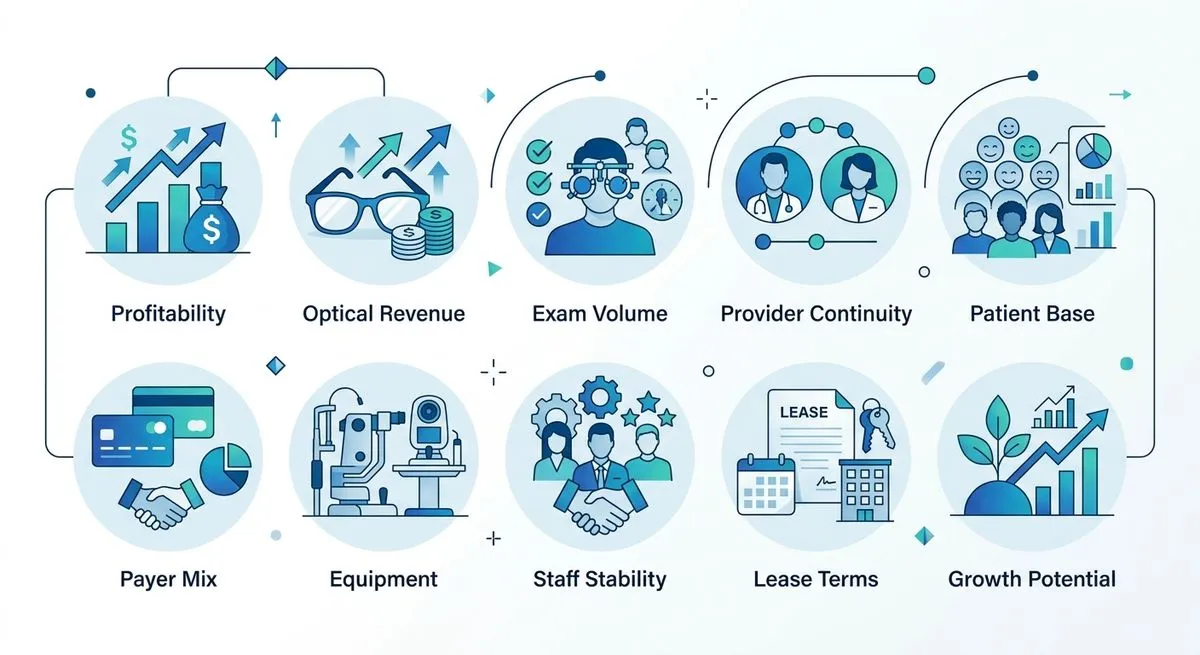
If you’re asking “what is my optometry practice worth?”, the answer depends on more than annual revenue. Buyers look at profitability, owner dependence, optical revenue quality, exam volume, payer mix, provider continuity, staff stability, equipment, lease terms, growth potential, and your role after closing.
Many owners want a simple multiple. Industry ranges are a useful starting point (see the table below), but value isn’t only a formula. Two practices with the same revenue can attract very different interest if one has clean financials, strong optical margins, associate coverage, recurring patient demand and a smooth transition plan, while the other depends entirely on the owner and has inconsistent books.
The right way to think about it: buyers pay for future cash flow and confidence in the transition. The more predictable the practice looks after you step back, the stronger the interest is likely to be. Right Fit Capital doesn’t value practices, but for a starting point, the optometry valuation calculator gives an educational estimate in about a minute.
What is my optometry practice worth in a sale?
An optometry practice is worth what a qualified buyer will pay based on its earnings, risk, growth opportunity and fit with the buyer’s goals. Many buyers look at adjusted EBITDA or seller’s discretionary earnings, then apply a multiple based on size, quality and risk.
But “a multiple of earnings” is only the start. Buyers also ask whether the earnings will continue. If revenue depends heavily on the selling doctor, staff are unstable, optical sales are falling or the lease is uncertain, the buyer may discount the value even when historical revenue looks strong.
So the question isn’t only “how profitable is the practice?” It’s also “how transferable is that profit to a new owner?”
The main valuation methods buyers use
Buyers and advisers use several methods: earnings-based valuation, revenue cross-checks, an asset review, and market comparables.
Earnings-based valuation
Buyers review profit after normalizing owner compensation, personal expenses, one-off costs and other add-backs. For larger or institutional buyers, EBITDA is usually the key measure. For smaller individual buyers, seller’s discretionary earnings may matter too.
Revenue cross-check
Revenue matters, but rarely tells the whole story. A high-revenue practice with weak margins may be less attractive than a smaller one with cleaner profit. Buyers use revenue as a rough check, but care more about durable earnings and transition risk.
Asset and equipment review
Diagnostic equipment, optical inventory, exam lanes, EHR systems, furniture, fixtures and technology all affect value. Current equipment reduces near-term capital needs; outdated equipment may bring a discount if immediate investment is needed.
Market comparables
Comparable sales can frame value, but they’re imperfect. Size, location, payer mix, optical revenue, provider coverage, real estate and buyer type all affect how comparable another sale really is.
EBITDA, seller’s discretionary earnings and owner pay
One of the most important issues is how owner compensation is treated. A buyer needs to know what the practice earns after paying a replacement doctor or owner-operator a market salary.
If the practice shows strong profit because you underpay yourself, a buyer will adjust earnings down. If personal or one-off expenses run through the business, a buyer may add them back if they’re legitimate and well documented.
Common adjustments include:
- Owner compensation normalized to market pay
- Personal expenses run through the business
- One-off legal, consulting, repair or transition costs
- Non-recurring revenue or unusual costs
- Family payroll adjusted if pay is above or below market
- Rent normalization if you also own the real estate
Clean documentation matters. Buyers are far more likely to credit add-backs when the story is clear and supported.
Typical optometry practice multiples in 2026
Industry reports give a rough guide to the multiples buyers apply. These are the ranges reported for US optometry practices from 2024 through early 2026.
| Practice size and earnings | Typical range, 2024 to Q1 2026 |
|---|---|
| Single-OD practice, under $500K SDE | 2.5x to 4.5x SDE |
| $500K to $1M of earnings | 3.5x to 5.5x SDE, or 4.5x to 6.5x adjusted EBITDA |
| Multi-OD or multi-site, $1M to $3M adjusted EBITDA | 6x to 8.5x |
| Regional group, $3M to $10M adjusted EBITDA | 7.5x to 10x |
| Platform, $10M+ adjusted EBITDA | 10x to 14x |
Source: CT Acquisitions, Optometry Practice M&A Multiples Report 2026 (July 2026), drawing on BizBuySell, IBBA, Provident Healthcare Partners, Skytale Group and Cleinman Performance Partners. Treat the ranges as directional, not an appraisal.
The same report puts a few adjustments on top: specialty services such as dry eye, myopia management or scleral lenses add about 0.5 to 1.5 turns; owned real estate, or real estate leased to the practice at market rent, adds about 0.25 to 0.75; a practice subleased inside a retail store sells for about 0.5 to 1.5 turns less than a standalone office. Review of Optometric Business puts optometry practices overall at around 3x to 6x EBITDA (Review of Optometric Business, 2025).
Two cautions. Seller’s discretionary earnings (SDE) includes the owner’s pay, so it attracts a lower multiple than adjusted EBITDA; never apply one to the other. And the multiple sets the headline value, not what you take home: cash at closing, rollover equity, earn-outs and debt all change the outcome (see optometry practice sale terms).
Optical revenue and capture rate
Optical revenue can be a major value driver because it affects margins, patient lifetime value and growth potential. Buyers look beyond total optical sales to how repeatable and well managed the optical business is:
- Optical revenue as a share of total revenue
- Capture rate after exams
- Frame and lens margins
- Inventory management
- Vendor relationships
- Premium lens and specialty product mix
- Staff sales training and optical workflow
Strong optical operations attract buyers who see upside from merchandising, purchasing power, pricing, lab relationships and operational improvements. A practice with weak or declining optical revenue can still sell, but buyers will want to understand why.
Exam volume, patient base and payer mix
Buyers want to know whether demand is stable and will continue. Exam volume shows patient flow, retention shows loyalty, and payer mix shows reimbursement quality and predictability.
- How many comprehensive exams does the practice perform each year?
- Are visits growing, flat or declining?
- How much revenue comes from managed vision plans?
- How much is private pay or medical optometry?
- Are patients attached to you personally or to the practice?
- How strong are recall and reactivation?
- Are there referral sources or employer relationships?
Stable demand reduces buyer risk. If visits are declining, buyers will ask whether the cause is marketing, capacity, competition, staffing, payer pressure or the owner slowing down. Long-term demand helps: VisionWatch projects medical eye exams to grow about 26.5% between 2020 and 2030 as the population ages (as reported by Review of Optometric Business).
Provider continuity and owner dependence
Provider continuity is one of the biggest value issues in optometry. A practice that depends entirely on its owner is harder to transition than one with associates or a clear replacement plan.
Buyers want to know:
- Will you stay after closing, and for how long?
- Will associate optometrists stay?
- Are provider schedules full?
- Can production continue if you cut your hours?
- Is there room to recruit another provider?
Being willing to support a transition helps preserve value. But the details matter: employment terms, clinical schedule, pay, non-compete, patient handoff and timeline should all be clear before signing a final agreement. Our guide to optometry practice sale terms covers employment agreements in detail.
Location, lease, equipment and real estate
Buyers evaluate visibility, parking, accessibility, local demographics, nearby competition, exam lanes, equipment, optical layout and expansion potential.
Lease terms are especially important. A buyer may hesitate if the lease is expiring, rent is above market, assignment rights are unclear, or the landlord hasn’t approved a transfer. If you own the real estate, the buyer needs to know whether it will be sold, leased or kept separate.
Equipment matters too. Current diagnostic equipment makes a practice easier to transition; gaps reduce perceived value if the buyer expects near-term capital spending.
Buyer type changes the valuation lens
Different buyers value the same practice differently. An individual optometrist, a regional group, a corporate platform and a private-equity-backed buyer each have different reasons to buy.
An individual buyer may focus on whether the practice can support debt payments and an owner’s income. A corporate buyer may focus on systems, integration, provider coverage, optical performance and market density. A local or regional buyer may value the location, patient base, staff and room to expand. A private-equity-backed platform may care about EBITDA quality, scalability and future add-on potential.
That’s why value isn’t a number in isolation: it’s a fit between the practice and the buyer. See how to find buyers for an optometry practice, what optometry practice buyers want, and private equity optometry practice buyers.
Deal terms matter as much as the headline price
The highest offer isn’t always the best. Compare total value, cash at closing, seller financing, earn-outs, rollover equity, your employment agreement, non-compete, transition period, real estate terms and certainty of closing.
One buyer may offer a higher headline price but require a long earn-out or aggressive targets. Another may offer less but more cash at closing and a cleaner transition. Depending on your goals, the second may be better. Before choosing, compare:
- Cash paid at closing
- Contingent payments or earn-outs
- Seller financing
- Rollover equity
- Your pay and schedule after the sale
- Non-compete and restrictive covenants
- Real estate sale or lease terms
- Staff retention commitments
- Certainty to close
Always read value together with structure.
How to prepare for a stronger valuation conversation
Preparation doesn’t mean making the practice look perfect. It means making the business easy to understand:
- Clean up your financial statements.
- Document add-backs clearly.
- Separate personal and business expenses.
- Track optical performance and capture rate.
- Review payer mix and revenue by category.
- Organize equipment lists and lease documents.
- Understand staff roles and pay.
- Decide whether you want to stay after closing.
- Identify growth opportunities a buyer could reasonably pursue.
The easier it is for a buyer to understand the practice, the easier it is to make a serious offer. Our checklist for preparing to sell lists the documents buyers ask for.
So, what is your optometry practice worth?
Start with adjusted earnings, then look at what makes them durable: optical performance, patient demand, provider continuity, staff stability, clean records, location, equipment and your transition plan. The real number comes from buyers who know your practice.
Right Fit Capital introduces optometry owners confidentially to qualified buyers, so you can hear what the market will pay before committing to anything. There is no cost to the seller. Read how to sell an optometry practice confidentially, see how matchmaking works, or book a 15-minute intro call.