
Sell Optometry Practice Confidentially: Owner Guide

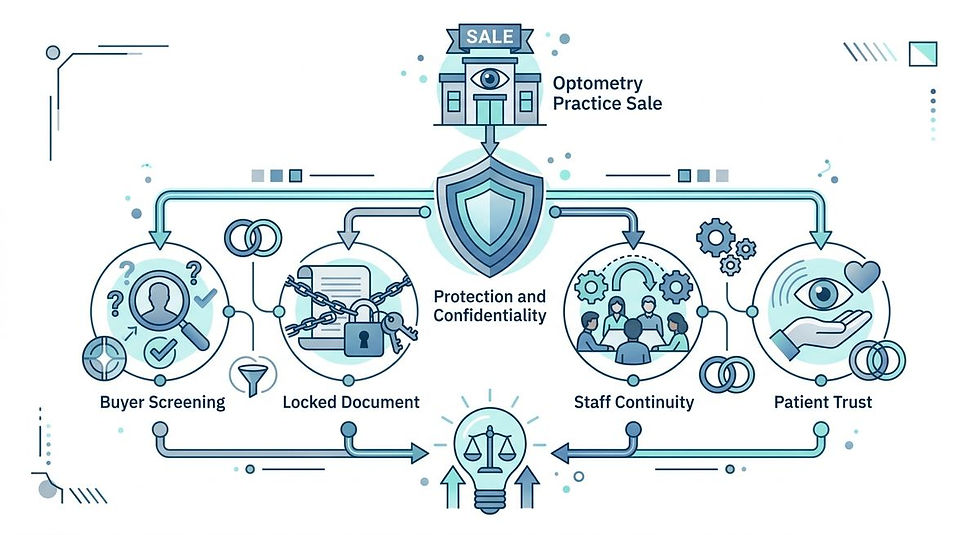
If you want to sell optometry practice confidentially, the process should not start with a public listing or a blast email to every buyer in the market. It should start with a controlled plan: define your goals, protect your identity, qualify buyers before sharing sensitive information, use staged disclosure, and only move into deeper conversations when a buyer is credible and aligned.
Confidentiality matters because an optometry practice is a relationship-driven healthcare business. Staff, patients, referral sources, vendors, landlords, and competitors can all react badly if they hear that the practice may be for sale before there is a real plan. Even if you ultimately decide not to sell, a premature rumor can create unnecessary disruption.
The good news: you can explore buyer interest without broadcasting your plans. A confidential optometry practice sale is possible when information is shared carefully, buyers are screened early, and the process is built around privacy from the beginning.

Why Confidentiality Is So Important in an Optometry Practice Sale
Most optometry owners do not want the market to know they are considering a sale until they are ready. That instinct is right. A practice sale affects people who may not understand the difference between “exploring options” and “the practice is being sold tomorrow.”
Confidentiality protects several groups and relationships:
Staff: employees may worry about job security, compensation, schedule changes, or new management.
Patients: patients may wonder whether their doctor, care experience, insurance acceptance, or optical service will change.
Associate ODs: providers may become uncertain about their future if they hear rumors without context.
Competitors: nearby practices may use sale rumors to recruit staff or patients.
Referral relationships: local physicians, employers, schools, and community partners may misread the situation.
Landlords and vendors: a possible sale can trigger questions before there is anything concrete to discuss.
Confidentiality is not about hiding forever. It is about controlling timing, context, and information flow so the transition is introduced when there is a real plan.
Can You Sell Optometry Practice Confidentially Without a Public Listing?
Yes. You can sell optometry practice confidentially without publicly listing it. Many owners begin with anonymous or limited information, speak only with pre-screened buyers, and require an NDA before deeper details are shared.
A public listing may make sense for some owners, but it is not required. In many optometry transactions, a targeted buyer-introduction process is more appropriate. Instead of announcing the practice broadly, the owner or advisor identifies likely buyer types and approaches only qualified parties.
This approach can be especially useful if you are not certain you want to sell yet. You can learn which buyers may be interested, what questions they ask, and whether your goals match the market before committing to a wider process.
What Information Should Stay Private at First?
Early in the process, do not share more than necessary. Buyers need enough information to assess whether the opportunity might fit, but they do not need your full financials, staff list, patient list, lease, vendor contracts, or practice identity before they are qualified.
Information that usually stays private until later includes:
Practice name and exact address
Detailed profit and loss statements
Tax returns
Patient lists or patient-level data
Employee names, compensation, or HR details
Lease documents
Vendor contracts
Managed vision plan contracts
Detailed optical sales reports
Owner compensation and personal add-backs
At the beginning, a buyer may only need a high-level picture: region, approximate revenue range, provider model, optical mix, owner transition preference, and general practice type. More sensitive information can come later, after fit and confidentiality are established.
How Staged Disclosure Works
Staged disclosure is the core of a confidential sale process. It means information is released in layers rather than all at once.
A typical staged process may look like this:
Owner goals: clarify timing, desired role after closing, confidentiality concerns, and buyer preferences.
Anonymous overview: describe the opportunity without identifying the practice.
Buyer screening: confirm the buyer is relevant, financially capable, and serious.
NDA: require a written confidentiality agreement before deeper disclosure.
Practice profile: share more detailed financial, operational, and transition information.
Introductory conversation: let owner and buyer assess fit before moving toward an indication of interest or LOI.
Diligence: provide deeper documents only after there is a clear transaction path.
This structure keeps the process moving while reducing unnecessary exposure.

What an NDA Does — and Does Not Do
An NDA is important, but it is not magic. It creates legal obligations around confidentiality, but it does not replace buyer screening, judgment, or careful information control.
An NDA can help restrict a buyer from sharing confidential information, using it outside the transaction process, or discussing the opportunity with unauthorized parties. It may also define who within the buyer’s organization can access the information.
But an NDA does not guarantee that every buyer is a good fit. It does not prove the buyer can close. It does not mean you should immediately share everything. The strongest process uses an NDA as one layer of protection, not the only layer.
Before sharing sensitive information, ask:
Is this buyer relevant to optometry?
Have they acquired practices before?
Are they financially capable?
Do they understand provider transition risk?
Would they be a realistic fit for my goals?
Who exactly will receive the information?
If those answers are weak, the NDA alone is not enough.
How to Protect Staff Morale During a Confidential Sale
Staff concerns are often the biggest confidentiality issue. Your team may have helped build the practice for years. If they hear vague rumors, they may assume the worst.
Before any staff communication, an owner should understand the likely buyer’s intentions around employment, compensation, scheduling, management structure, benefits, branding, and operational changes. Some buyers want continuity. Others may plan more significant integration.
Do not tell staff too early just to “be transparent” if there is no clear answer to their obvious questions. But do not ignore staff planning either. The goal is to communicate when you can explain what is happening, why it is happening, and what it likely means for them.
Strong staff planning includes:
Understanding buyer expectations before announcement
Protecting key employees from unnecessary uncertainty
Planning timing around LOI, diligence, and closing milestones
Preparing clear answers about roles, pay, benefits, and reporting lines
Making the transition feel organized rather than sudden
How to Protect Patients and Local Reputation
Patients usually do not need to know about early buyer conversations. They need clarity when a real transition is happening and when the message can be delivered with confidence.
In optometry, patients care about continuity: whether they can keep seeing the same doctor, whether insurance will still be accepted, whether optical service will change, whether records remain accessible, and whether the practice experience will feel familiar.
A buyer who understands patient continuity can be more valuable than a buyer who simply offers a strong headline price. If patient trust is damaged, the business can suffer after closing.
Confidentiality protects the practice until the owner and buyer are ready to explain the transition in a way that preserves confidence.
Which Buyers Can Handle a Confidential Process?
Not every buyer handles confidentiality the same way. Some buyers are sophisticated and understand staged disclosure. Others push for too much information too early.
Common optometry buyer types include individual ODs, regional eye-care groups, corporate optometry platforms, private equity-backed buyers, and strategic acquirers. Each buyer type may have a different diligence style.
Individual buyers may need more time and financing support, but they may be easier to evaluate personally. Corporate and private equity-backed buyers may have more formal diligence teams, but the seller should still control what is shared and when. Strategic buyers may understand the market well, but they may also be competitors or adjacent operators, which makes confidentiality especially important.
For a deeper look at buyer categories, see Right Fit Capital’s guide on how to find buyers for an optometry practice and its article on what optometry practice buyers want.
Red Flags That Confidentiality May Be at Risk
Some buyer behavior should make an owner pause. Confidentiality problems often start with poor process discipline.
Watch for buyers who:
Ask for detailed financials before explaining their acquisition criteria
Want the practice name before being screened
Refuse or delay signing an NDA
Cannot explain who will see the information
Are direct local competitors without clear safeguards
Push to contact staff, landlords, or vendors too early
Focus only on price without asking transition questions
Move sensitive information into uncontrolled email chains
A serious buyer should understand why confidentiality matters. If they do not, they may not be the right buyer.
How Right Fit Capital Helps Owners Explore Confidentially
Right Fit Capital helps optometry practice owners explore sale options and buyer interest confidentially. The process is designed for owners who want to understand potential buyer fit without immediately putting the practice on the open market.
Right Fit Capital helps owners clarify goals, identify buyer types, and facilitate conversations with qualified parties under a controlled process. That can include individual optometrists, regional eye-care groups, corporate platforms, private equity-backed buyers, and strategic acquirers.
Owners can also review Right Fit Capital’s M&A matchmaking process, seller-focused overview on the For Sellers page, and related guidance on whether an optometry owner needs a broker.
FAQ: Sell Optometry Practice Confidentially
Can I sell my optometry practice confidentially?
Yes. An optometry owner can explore a sale confidentially by avoiding public listings, using anonymous initial information, screening buyers before disclosure, requiring NDAs, and sharing sensitive documents only in stages.
When should I tell my staff I am selling?
Most owners wait until there is a clear transaction path and enough information to answer staff questions. Telling staff too early can create uncertainty, but waiting too long without a communication plan can also create problems. Timing should be planned around the buyer, LOI, diligence, and closing timeline.
What can I share before an NDA?
Before an NDA, keep information general. You may share high-level region, approximate revenue range, practice type, provider model, and broad owner goals without identifying the practice or sharing detailed financial, staff, patient, or lease information.
Does an NDA fully protect my practice?
An NDA helps, but it is only one layer of protection. Buyer screening, staged disclosure, controlled document sharing, and careful timing are also important. Do not share highly sensitive information with a buyer just because an NDA has been signed.
Can I explore buyer interest without committing to sell?
Yes. A confidential buyer-introduction process can help an owner understand likely buyer interest, buyer fit, and common questions before deciding whether to move forward with a full sale process.
Bottom Line
To sell optometry practice confidentially, control the process from the start. Do not overshare early. Do not rely only on a public listing. Screen buyers, use NDAs, release information in stages, and protect staff and patient confidence until there is a real transition plan.
Right Fit Capital helps optometry owners explore sale options discreetly and connect with qualified buyers under a confidential process. To start a private conversation, visit rightfitcapital.com.


