
How to Sell an Optometry Retail Practice When the Buyer Wants Only the Lease, Equipment, or Patient Flow

An optometry practice owner may expect buyers to value the entire business: clinical earnings, optical sales, staff, patient relationships, equipment, inventory, brand, systems and location. Then an interested buyer makes a very different proposal. It wants the lease but not the entity. It wants the exam equipment but discounts the optical inventory. Or it wants the location and expected patient flow while assigning little value to the goodwill the owner spent decades building.
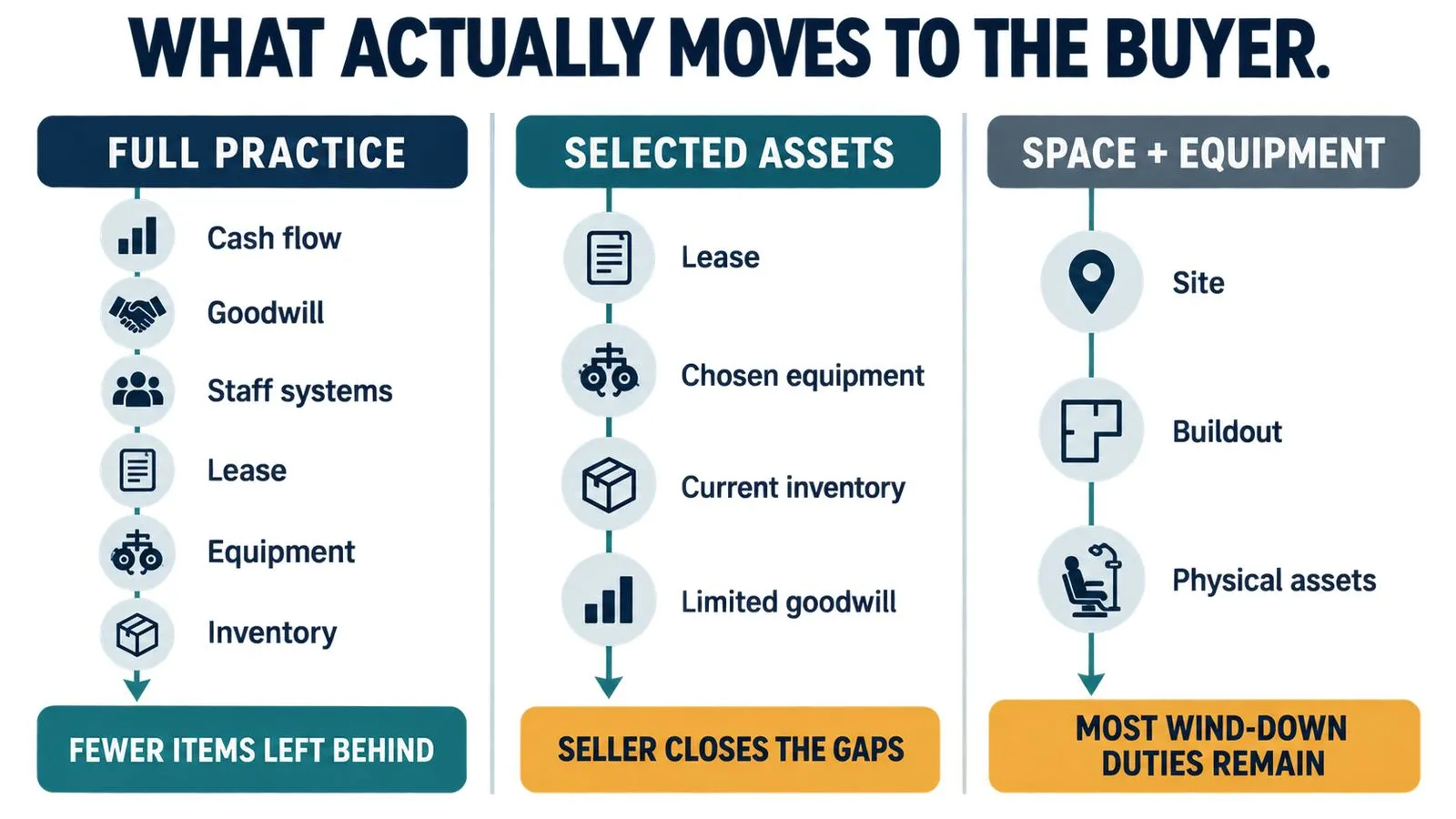
That doesn’t necessarily mean the practice has no value. It means the buyer is defining the transaction differently. A full going-concern acquisition, a selective asset purchase and a lease-and-equipment deal can produce very different outcomes, even when the headline offer looks similar.
The short answer: to sell an optometry retail practice well, first separate the business into its value layers, then compare what each offer includes and what stays with you. A buyer that picks only the most useful assets may leave you with lease exposure, employee costs, obsolete inventory, vendor commitments, record-retention duties, debt and shutdown work. The right comparison isn’t the offered price. It’s your net outcome after every retained obligation is counted.
Before you sell an optometry retail practice, separate the value layers
An optometry retail practice isn’t one indivisible asset. It’s a bundle of tangible and intangible elements that work together to produce cash flow, and different buyers value each part differently.
- Transferable earnings: the normalized profit a buyer believes will continue after you leave.
- Clinical goodwill: patient relationships, referral sources, recall behavior, reputation, provider continuity, and the likelihood that patients stay.
- Optical goodwill: the ability to convert exams into eyewear sales, keep repeat purchasing, manage product mix and protect margins.
- Lease and location rights: visibility, parking, nearby demand, tenant improvements, renewal options, rent, assignment rights and landlord cooperation.
- Equipment and fixtures: exam-lane equipment, imaging and diagnostic technology, optical displays, furniture, computers and leasehold improvements.
- Inventory: frames, lenses, contact lenses, accessories, supplies, and any slow-moving or obsolete stock.
- Operating infrastructure: staff, phone numbers, domain names, scheduling and recall systems, vendor relationships, payer participation, policies and workflows.
- Brand and intellectual property: practice name, website, local search presence, marketing assets and other transferable identifiers.
A going-concern buyer usually pays for the coordinated system. A selective buyer may care mostly about one or two components. A nearby group may want a strong location and patient access but already have its own brand, lab contracts, software and back office. An individual optometrist may value the staff, equipment and established patient base, because recreating them from scratch would be hard.
That’s why a single rule of thumb based on collections can mislead. Our guide to what an optometry practice is worth explains the broader valuation factors, and the optometry valuation calculator gives an educational estimate. In a retail-heavy practice, the next question is more specific: which parts of the historical earnings would truly transfer to this buyer?
Three deals owners often mistake for the same sale
1. A full going-concern sale
The buyer acquires the operating practice, or a defined package of operating assets, and expects it to continue with little disruption. The package may include equipment, selected inventory, goodwill, business identifiers, phone and digital assets, patient-record custodianship, staff transition, restrictive covenants, and a lease assignment or new lease.
The buyer is paying for continuity, not objects. The value depends on whether revenue, staff knowledge, patient retention, referral patterns, optical conversion and normalized earnings survive the change in ownership.
2. A selective asset purchase
The buyer picks specific assets and excludes the rest. It may buy newer diagnostic equipment, current frame inventory, the phone number, domain and certain goodwill rights while refusing older equipment, aged stock, receivables, liabilities or contracts.
This structure isn’t inherently unfavorable. It can create a clean, focused deal when both sides understand the boundaries. The danger is assuming the excluded items cost nothing. Every obligation, asset and responsibility that doesn’t move to the buyer stays somewhere, usually with you.
3. A lease, space and equipment transaction
Sometimes the buyer wants a ready-to-use eye care location more than the business itself. It values the buildout, exam lanes, optical displays, parking, signage and favorable rent, and plans to install its own staff, systems, brand and inventory.
Economically, this looks more like transferring an improved location than selling a functioning practice. If so, compare the offer with your other options: a full-practice buyer, an orderly wind-down, selling the equipment separately, or continuing to operate while you make the practice easier to transfer.
Why a buyer may discount your goodwill
Goodwill isn’t a reward for years worked. It’s the buyer’s estimate of future economic benefit, and a buyer discounts it when it sees a real risk that earnings won’t transfer.
Common reasons include:
- The owner drives most clinical production. If patients come mainly for one doctor who plans to leave quickly, retention is uncertain.
- The optical depends on the owner’s taste or selling style. A buyer may doubt that frame selection, merchandising and conversion will stay strong without you.
- Revenue isn’t cleanly separated. When the financials don’t split exams, medical services, eyewear, contact lenses, lab costs and provider production, a buyer can’t confidently value the parts it wants.
- Inventory is old or poorly documented. Book value isn’t realizable value. Discontinued frames and slow-moving products have little appeal.
- The recall engine is weak. A large historical database doesn’t equal active demand. Buyers look for recent visits, booked appointments, recall performance and repeat behavior.
- The lease creates risk. Above-market rent, a short remaining term, weak renewal rights, assignment restrictions or an uncooperative landlord reduce the value of every other asset.
- Equipment needs replacing. Buyers care about age, service history, liens, software compatibility, warranties and remaining useful life, not the tax schedule.
- The buyer already owns overlapping infrastructure. Its own brand, systems, vendor contracts, lab network and management platform may make some of your assets redundant.
The best response isn’t to argue that goodwill must be worth more. It’s to show, with evidence, which patient relationships, earnings, systems and advantages are likely to continue after closing.
If the buyer wants the lease
A buyer may want the site because it would be expensive or impossible to reproduce nearby. Buildout, plumbing, electrical capacity, exam-room layout, optical displays, accessibility, parking, visibility and local demographics can create real location value.
Before treating lease interest as a practice offer, find out:
- Whether the lease can be assigned, and whether the landlord’s written consent is required.
- Whether the buyer will assume the existing lease or sign a new one.
- Whether you stay liable under a personal guarantee after assignment.
- How the security deposit, prepaid rent, tenant allowances and restoration obligations will be handled.
- Whether signage, exclusivity, renewal options and permitted use transfer.
- Which leasehold improvements stay with the property and which may be removed.
- What happens if landlord consent is delayed or refused.
A valuable location creates leverage, but only if you can legally and practically transfer it. Pull together the lease, amendments, notices, guarantees and landlord correspondence early. A buyer that needs the site may move quickly; a missing consent right can stop the deal.
If the buyer wants the equipment or inventory
Evaluate equipment item by item, not as one number on a depreciation schedule. List the manufacturer, model, serial number, purchase date, ownership or lease status, service history, software dependencies, liens, condition, and whether it’s included.
Clarify whether the price covers removal, delivery, installation, calibration, data removal, software transfer and sales tax. An imaging device may be physically transferable while its software license, cloud subscription or service contract isn’t.
Inventory needs the same discipline. Separate current, saleable frames and contact lenses from discontinued, damaged, demo, consignment or slow-moving stock. Agree on how it’s counted and valued, and how the closing-date adjustment works. A buyer may reasonably pay a different rate for current stock than for aged stock.
Don’t let a narrow equipment offer quietly capture other value. If the buyer also gets the fitted-out space, phone number, website, signage rights, staff introductions or access to future patient demand, the agreement should name and price those elements rather than calling everything used equipment.
If the buyer wants “patient flow”
Patients aren’t inventory, and no seller can promise a patient will choose the buyer. What can transfer is a carefully structured package of continuity assets and obligations: goodwill rights, communication channels, record-custodianship arrangements, appointment schedules, recall systems, staff knowledge, a transition plan, and your introduction of the successor.
Patient records and protected health information need particular care. Use healthcare counsel to address state law, privacy rules, patient notices, access rights, retention requirements, system migration, breach risk, and who serves as custodian. A spreadsheet of names isn’t a compliant transition.
On value, buyers may look at:
- Active patients, defined by a recent and defensible time period.
- New versus returning patient volume.
- Booked appointments and recall activity.
- Exam-to-optical conversion and capture rate.
- Patient concentration by provider, payer, employer or referral source.
- How many patients use the practice for both clinical care and optical purchases.
- How long you’ll stay for the transition, and provider coverage after closing.
- Staff retention, phone continuity, website control and local search visibility.
If a buyer expects strong patient retention but offers nothing for goodwill, ask it to reconcile the two. It may prefer to tie part of the price to measured retention. That shifts risk to you, so the measurement period, baseline, exclusions, data access, operational control and payment protections matter as much as the headline amount.
Compare net outcomes, not headline offers
A selective-asset offer can look attractive because it’s simple and may close quickly. But a lower-priced going-concern sale may leave you with fewer residual costs. Build a side-by-side closing model for every serious proposal.
Start with the gross price, then account for:
- Debt, equipment liens and lease payoffs.
- Professional fees and transaction expenses.
- Taxes and the purchase-price allocation.
- Employee notice, accrued pay, benefits and severance.
- Landlord, lease-assignment, restoration and guarantee exposure.
- Vendor termination costs and contracts that can’t transfer.
- Unsold equipment, inventory and furniture, and disposal costs.
- Accounts receivable collection and refund obligations.
- Patient-record conversion, storage, access and custodianship costs.
- Tail insurance, licensing, entity wind-down and administrative work.
- Deferred payments, holdbacks, contingencies and collection risk.
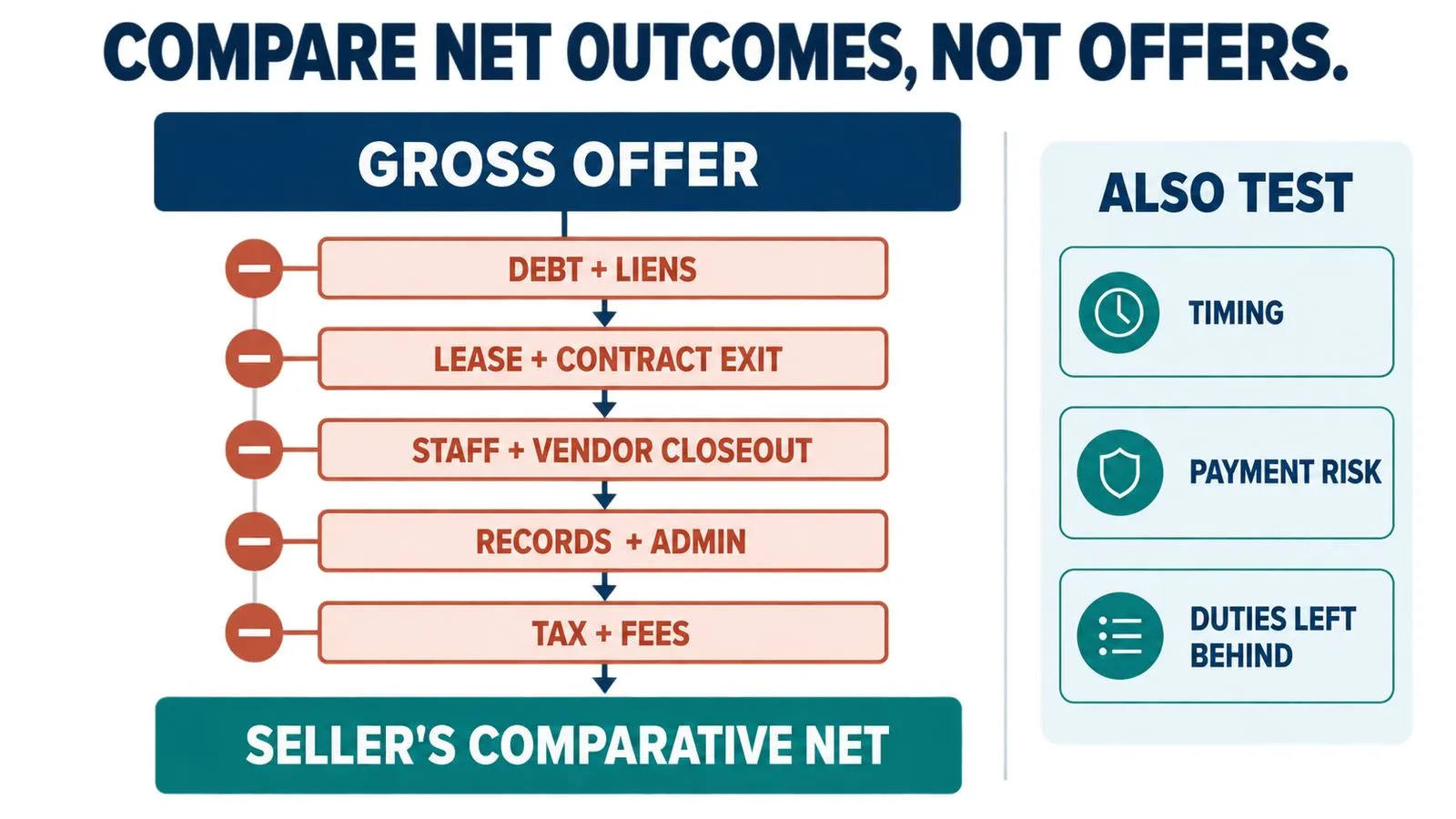
The model should also show timing and risk. Cash at closing differs from a payment contingent on future collections. A signed lease release differs from a buyer’s promise to pay rent while your guarantee stays in place. A clean transfer of record duties differs from an informal handoff that leaves responsibility unclear. Our guide to optometry practice sale terms explains how cash at close, earn-outs and holdbacks compare.
How to make a retail-heavy practice easier to transfer
You can often improve buyer confidence before going to market. The goal isn’t cosmetic. It’s proving the business can continue without undocumented owner effort.
- Separate the economics. Produce clean reporting for clinical services, eyewear, contact lenses, lab costs, payroll, provider production and normalized owner expenses.
- Age the inventory. Identify current stock, consignment goods, demos, damaged items and products unlikely to sell. Clear obsolete inventory before a buyer uses it to discount the whole optical.
- Document patient activity. Use consistent definitions for active patients, recall cohorts, conversion, repeat purchases, cancellations and booked appointments.
- Secure the location. Understand assignment rights, renewal options, market rent, guarantees, deferred maintenance and landlord requirements before diligence begins.
- List the assets. Match equipment to ownership documents, liens, warranties, service records and software agreements.
- Reduce owner dependence. Document merchandising, purchasing, recall, vendor, staffing and clinical workflows, and build capable staff around the functions you control today.
- Prepare a compliant continuity plan. Address patient communications, record access, data migration, staff messaging, referral relationships and your transition role with qualified advisers.
This preparation also helps you tell a buyer that understands the practice from one looking for discounted assets. Our checklist for preparing to sell lists the documents buyers ask for, and our guide to finding buyers for an optometry practice explains why buyer fit matters.
Terms that must be clear in a partial-asset deal
If the best outcome is a selective transaction, the agreement should define the boundaries precisely. At a minimum, you and your advisers should address:
- A detailed list of purchased and excluded assets.
- Which liabilities the buyer assumes and which stay with you.
- How inventory is counted, valued and adjusted at closing.
- Who obtains landlord, lender, vendor, payer and other consents.
- How patient records, notices, data access, privacy and custodianship are handled.
- Which names, phone numbers, domains, websites, listings and marketing assets transfer.
- Whether staff receive offers, and how accrued obligations are allocated.
- Your transition services, time commitment, compensation and end date.
- Restrictive covenants and their permitted scope under applicable law.
- Purchase-price allocation and responsibility for taxes.
- Closing conditions, prorations, holdbacks, indemnities and post-closing access.
These are legal, tax, employment, privacy and regulatory questions, not just business points, and the answers depend on the structure and the state. Involve healthcare transaction counsel and a tax adviser before signing a letter of intent that fixes the economics.
When to push for a full-practice buyer
A partial deal may be right when the practice is marginal, you need speed, the lease is unusually valuable, equipment carries most of the realizable value, or a clean going-concern transfer isn’t practical. But don’t accept a piecemeal outcome just because the first buyer frames the practice that way.
Reaching more buyers may be worth it when:
- The practice has durable normalized earnings.
- Active patient and recall data support transferability.
- The optical produces credible margins and the inventory is current.
- Staff and provider coverage can continue after closing.
- The lease is assignable and the rent is supportable.
- The buyer expects to benefit from the practice’s name, relationships, digital presence or systems.
- The selective offer leaves real wind-down costs or liabilities with you.
A confidential process can test different buyer types without publicly signaling that the practice is for sale. See our guide to selling an optometry practice confidentially, and how matchmaking works.
The best offer buys the right bundle and leaves a clean ending
To sell an optometry retail practice well, understand what the buyer is really acquiring and what you’ll still have to unwind. Lease rights, equipment, inventory, patient continuity, goodwill, systems and earnings are connected but not interchangeable. A buyer may reasonably value them differently; make sure the economics reflect the complete package.
Before accepting a narrow offer, prepare the asset schedules, patient and financial analysis, lease documents, inventory aging, transition plan and residual-cost model. Then compare complete outcomes across buyers. A lower-risk full-practice sale can be worth more than a larger selective offer that leaves you with years of obligations.
Right Fit Capital introduces optometry owners to qualified buyers confidentially, so you can compare how different buyers value the practice, the location, the operating platform and the transition. Learn more about selling an optometry practice, or book a 15-minute intro call. There is no cost to the seller.